Under the patronage and presence of Dr. Abdullah bin Abdulaziz Al-Subaie, Minister of Environment and Climate Change, the Ministry of Environment and Climate Change signs a cooperation program with Qatar Red Crescent
The Ministry of Environment and Climate Change signed this morning a joint technical cooperation program with Qatar Red Crescent to build joint national capacities in the fields of combating the effects of climate change and launching a national electronic platform for climate change.
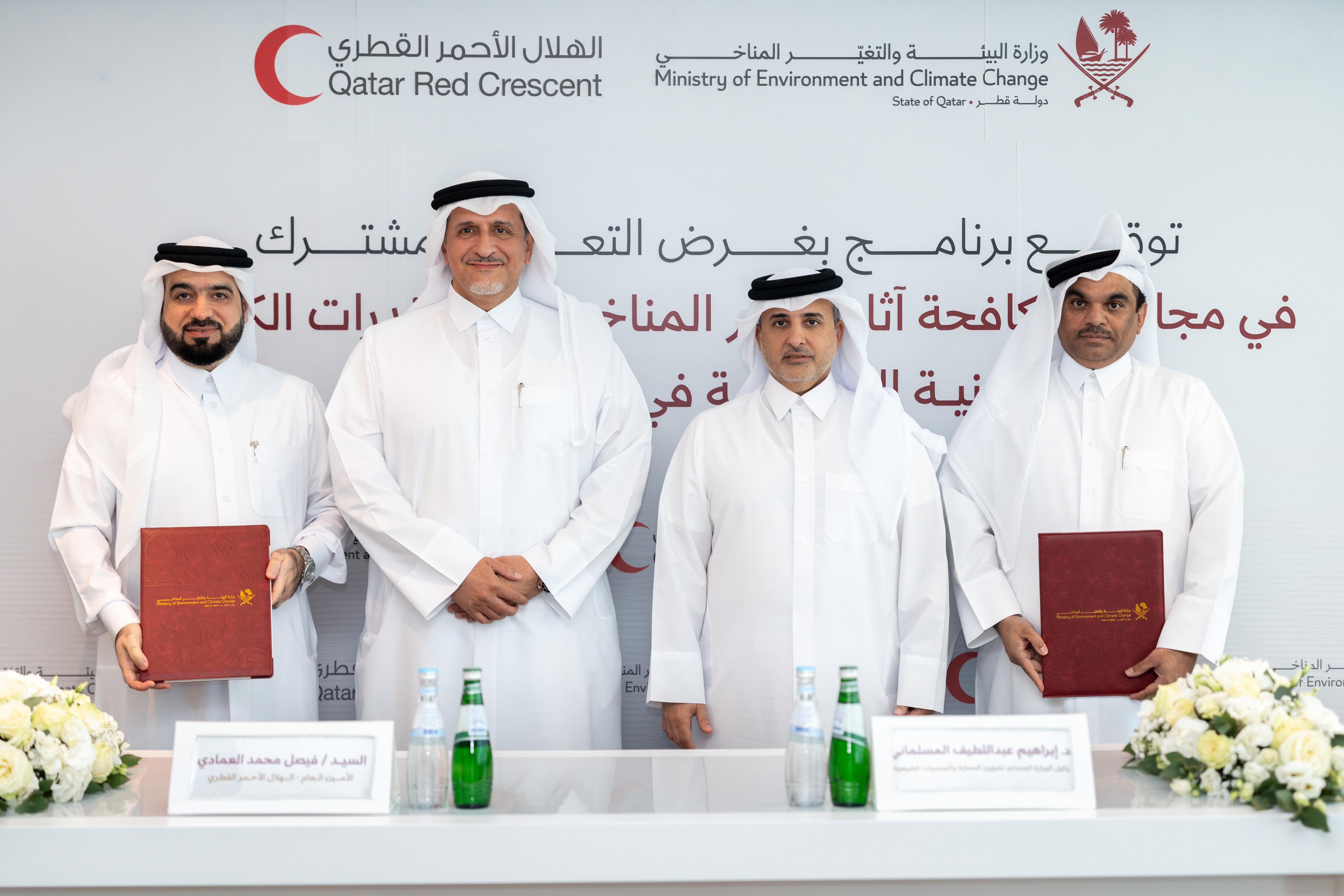
The program was signed under the patronage and presence of His Excellency Dr. Abdullah bin Abdulaziz bin Turki Al-Subaie, Minister of Environment and Climate Change, and in the presence of His Excellency Mr. Yousef bin Ali Al-Khater, Chairman of the Board of Directors of Qatar Red Crescent, where the program was signed by the Ministry of Environment and Climate Change, Dr. Ibrahim Al-Muslimani, Assistant Undersecretary for Protection and Protected Areas Affairs, and by the Qatar Red Crescent, Mr. Faisal Mohammed Al-Emadi, Secretary General, in the presence of officials from both parties.
In this context, Dr. Ibrahim Al-Muslimani stressed that the cooperation program comes within the framework of the efforts made by the Ministry to confront the phenomenon of climate change, by building bridges of cooperation and partnerships with national institutions that work in the field of serving communities and people, pointing out that working to help community members adapt to climate change is at the heart of charitable and humanitarian work, especially in external work, due to the suffering of the peoples of some countries from climate change, represented in increasing the rate of land desertification. Agriculture, hurricanes, and floods, which are challenges that cause the displacement of the populations of countries, and their suffering from famine and mass displacement.
Dr. Al-Muslimani pointed to the importance of launching the national electronic platform, which will enhance community awareness of climate change, as well as introducing sustainable development, its importance and its impact on the lives of citizens, pointing out that the first steps that contribute to avoiding the effects of climate change are to educate community members about environmental issues, and to introduce all types of pollution and its damage to the environment and its impact on human life, referring in this context to the objectives of the cooperation program, which will work to support this aspect through the development of Joint plans to increase community awareness of the risks of climate change, and transfer the extensive expertise possessed by the Ministry of Environment and Climate Change to all partners, thus contributing to adapting the effects of climate change.
Commenting on the signing of the cooperation program, Mr. Faisal Mohammed Al Emadi, Secretary General of Qatar Red Crescent, said: “We are pleased with this agreement, which frames the previous cooperation between Qatar Red Crescent and the Ministry of Environment and Climate Change, which resulted in many joint programs and initiatives in various files related to community service and environmental protection.”
He added: “We thank the brothers in the Ministry of Environment and Climate Change for their understanding and interest in launching this joint technical cooperation, which aims to harness the expertise and capabilities of both parties in building the capabilities of society to address one of the most serious challenges facing humanity in recent decades, which is the issue of climate change and the consequent weather and natural phenomena that affect members of society and affect the capabilities of their daily lives.”
The program is in line with the Third National Development Strategy 2024-2030, which aims to adopt effective measures to mitigate the effects of climate change, implement programs that enhance the behavior of community members towards the environment, and encourage them to fulfill the commitment set by the Qatar National Vision 2030 in preserving the environment for future generations, as the program aims to launch a national electronic platform for climate change, and employ joint expertise and technical capabilities to support efforts in the field of climate change issues.
Furthermore, it aims to intensify efforts to develop joint plans to increase community awareness of the risks associated with these issues. The cooperation program also focuses on implementing initiatives to mitigate the effects of climate change, particularly targeting school students. Additionally, it contributes to exchanging expertise and capacity-building for collaborative efforts aimed at reducing the impacts of climate change and adapting to them. It aims to stimulate and guide community action in response to climate and environmental crises, recognizing that climate change is one of the greatest global challenges facing humanitarian work.
This includes active participation in discussions related to climate change at the international level through collaboration with international organizations, which contributes to stimulating and directing humanitarian action towards climate and environmental crises, particularly benefiting groups suffering from the impacts of climate change. It also involves documenting activities and projects targeting those affected by natural disasters, enhancing coordination, and building partnerships with specialized institutions concerned with climate change inside and outside Qatar, as well as stakeholders investing in climate change adaptation.