MECC presents a distinguished participation at the Qatar Agricultural Exhibition
The Ministry of Environment and Climate Change is participating in the 11th edition of the International Qatar Agricultural Exhibition, organized by the Ministry of Municipality from February 21 to 27, 2024, at Expo 2023 Doha for Horticulture.
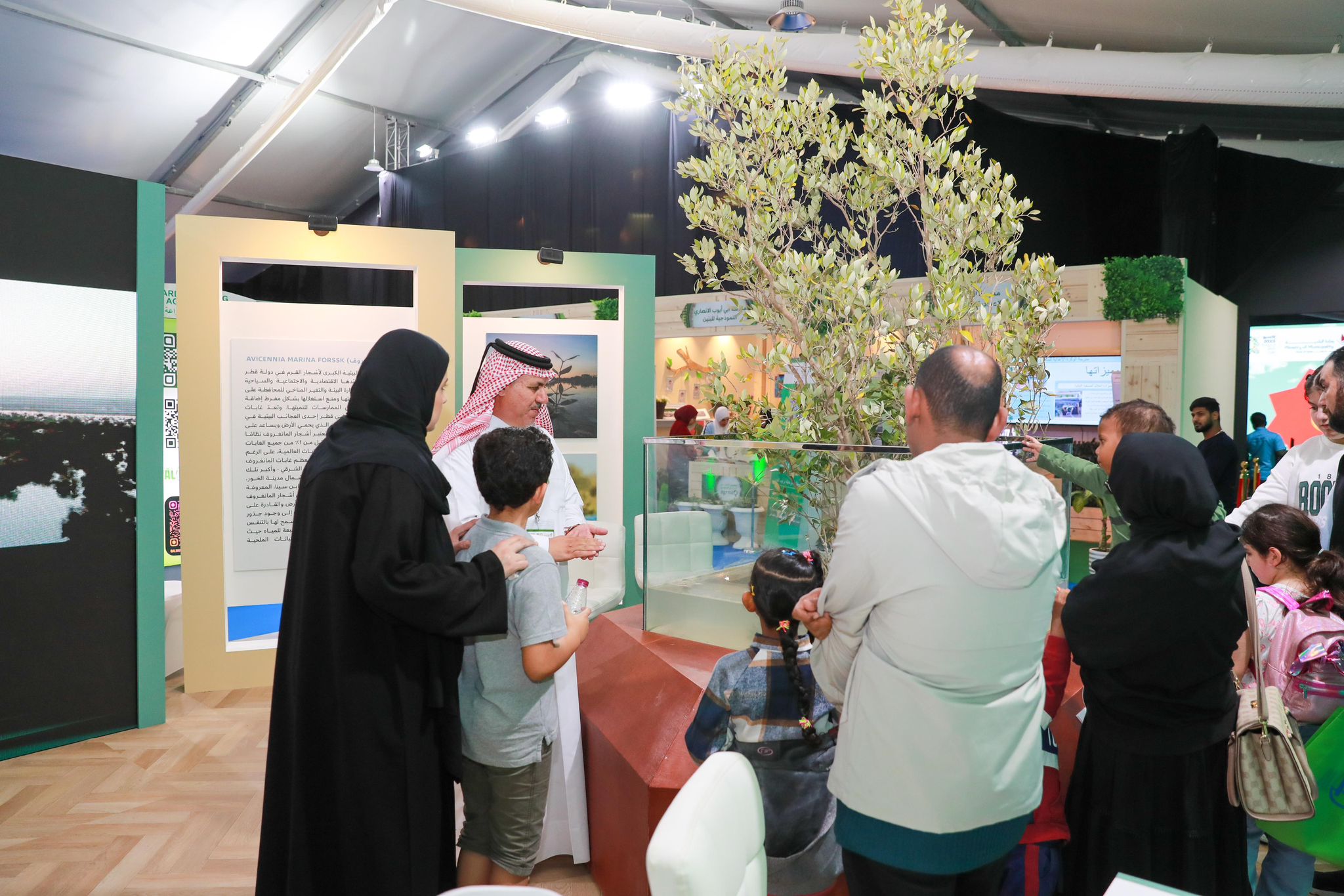
The ministry’s participation includes a dedicated pavilion at the Qatar International Agricultural Exhibition, where it showcases many of its achievements related to the agricultural sector. The pavilion highlights mangrove trees, emphasizing their importance for the environment and marine life during this edition of the exhibition.
In this context, Mr. Adel Al-Yafai from the Wildlife Development Department stated that the Ministry of Environment and Climate Change is making a notable contribution to the current edition of the agricultural exhibition by focusing on mangrove trees. These trees are considered vital for Qatar and the world in general. The aim is to raise local community awareness about the importance of these trees, which help protect the land and reduce the impact of tsunami waves by up to 90%. The exhibition provides detailed explanations about these trees and showcases their growth stages through models displayed at the pavilion.
Mr. Al-Yafai further emphasized in a press statement on the sidelines of the Ministry’s participation in the Qatar International Agricultural Exhibition that, given the significant environmental importance of mangrove trees in Qatar, along with their various economic, social, and tourism benefits, the ministry aims to preserve and protect mangrove trees from overexploitation. It also seeks to implement best practices for their development. He noted that mangrove forests in Qatar are among the country’s environmental wonders and serve as carbon reservoirs that protect the land and help renew life in the Gulf.
Mr. Al-Yafai pointed out that mangrove trees represent a very rare ecosystem, constituting less than 1% of all tropical forests and less than 4% of global forests, despite their presence in 123 countries. He highlighted that most of Qatar’s mangrove forests are located along the eastern coast, with the largest mangrove forests found in the Al-Dukhan area north of Al-Khor, consisting of various species such as the Ibn Sina Marina, also known as the gray mangrove.
He explained that mangrove trees belong to 2% of land plants capable of living in saline water, due to their specialized aerial roots that rise from the mud, allowing them to breathe despite the dense, water-saturated sediments where they grow. As a result, they are classified as halophyte plants. Mr. Al-Yafai confirmed that whether small or large, mangrove trees are evergreen, growing in seawater near the coast in tidal areas. They are fast-growing trees that thrive in poorly aerated muddy environments with aerial roots above the water to handle high salinity.